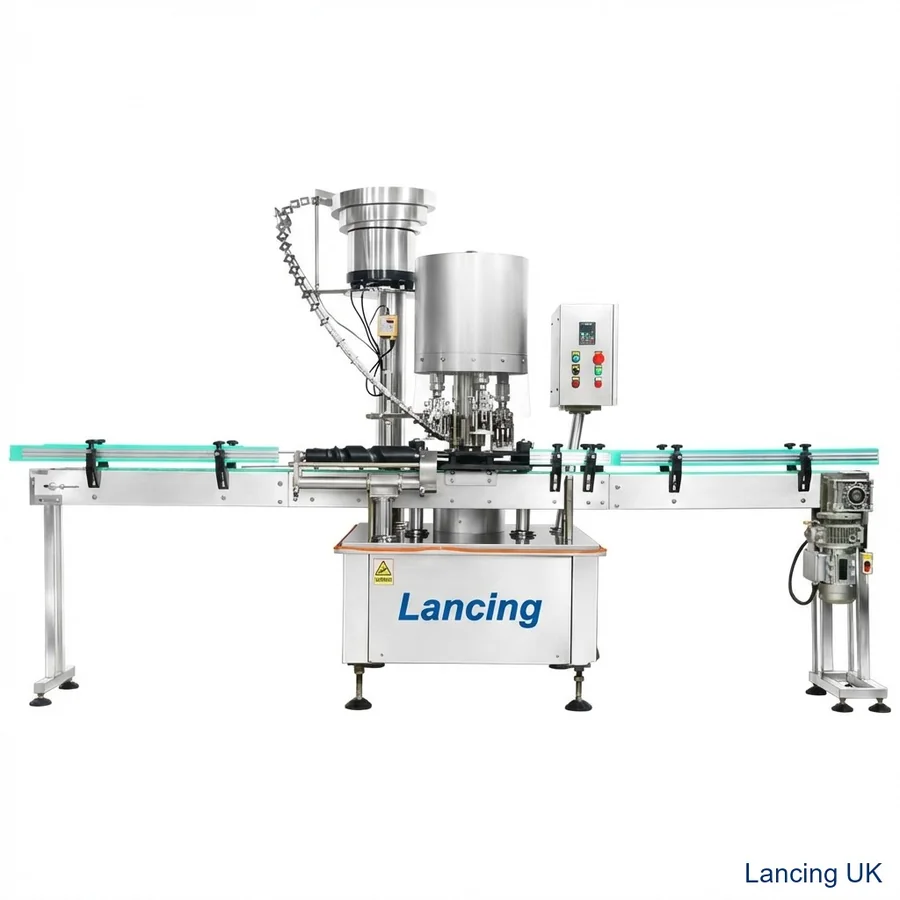
ROPP capping machines for beverage bottles and aluminium tamper caps.
Beverage lines need reliable sealing, attractive cap finish and repeatable opening torque. ROPP capping can be used for many still beverages, syrups and specialist drinks where aluminium tamper-evident caps are required.
Drinks production
Beverage capping has to control leaks and presentation.
For beverage products, the capper should be assessed using filled bottles, because liquid level, neck residue and bottle weight can influence capping performance. Leak checks and opening torque measurements are especially important.
The line may also need rinsing, filling, cap feeding, labelling, coding and case packing. Capping equipment should be selected in the context of the complete beverage line.
Beverage line checks
- Still or sensitive product
- Fill temperature
- Residue around bottle neck
- Bottle material and shape
- Cap liner compatibility
- Target output speed
- Leak-test procedure
- Labelling/coding position
Specification guide
Beverage ROPP quality controls
These controls support consistent shelf-ready packs.
| Area | Why it matters | Action |
|---|---|---|
| Leak checks | Protects product and cartons | Confirm liner and top pressure |
| Opening torque | Controls consumer experience | Test after capping and storage |
| Cap appearance | Protects brand finish | Inspect printed caps for scuffs |
Process
Practical route from enquiry to production.
These steps help turn the search query into a working ROPP capping specification.
1. Test with filled beverage bottles
Test with filled beverage bottles.
2. Set capper for liner compression
Set capper for liner compression.
3. Validate leak and torque results
Validate leak and torque results.
4. Inspect printed cap finish
Inspect printed cap finish.
5. Integrate with labelling and coding
Integrate with labelling and coding.
Related ROPP guidance
Continue the machine-selection process.
These pages cover the wider equipment range, technical checks and the enquiry route for samples and quotations.
FAQ
Questions about beverage ropp capping machine.
Can ROPP capping be used for beverages?
Yes, for suitable bottle and cap combinations, especially aluminium tamper-evident closures.
Should beverage samples be filled for testing?
Yes. Filled conditions better represent real production.
Is ROPP used for carbonated products?
Suitability depends on the product, pressure and closure system; samples and specifications should be reviewed.
Can the capper integrate with a beverage filling line?
Yes. Inline and rotary systems can be integrated with filling and labelling equipment.
Need help with this ROPP capping requirement?
Send your cap size, bottle height, neck finish, samples and target output for practical advice.