
Do not price an unknown pack
The sample trial can reveal tooling, feeding or seal requirements that are not visible in a photograph.
ROPP capping machine pricing depends on more than the machine frame. Automation level, cap feed, bottle handling, capping heads, change parts, controls, guarding, conveyor integration and validation work all affect the final quotation.
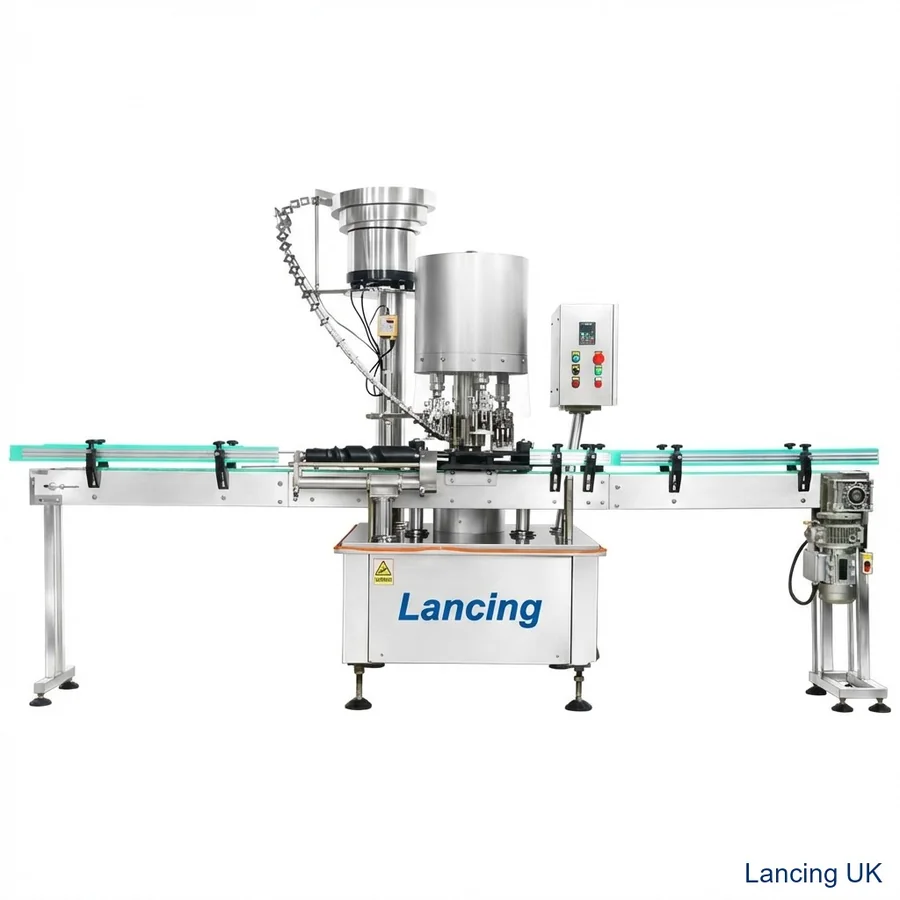
Cost drivers
A table-top ROPP capper and a rotary multi-head capper solve very different production problems, so comparing price without specification can be misleading. A small machine may be ideal for trials and short runs, while an automatic unit needs cap sorting, conveyor handling and controls suitable for line integration.
Lancing UK can quote more accurately when samples and production data are available. That reduces the risk of under-specifying the machine or buying equipment that later needs expensive modifications.
Specification guide
These are the main areas that move a ROPP capping project up or down in complexity.
| Area | Why it matters | Action |
|---|---|---|
| Manual cap placement | Lower complexity | Common on semi-automatic machines and small-batch work |
| Automatic cap feeding | Higher complexity | Adds cap handling, sorting and placement systems |
| Multiple bottle/cap formats | Change-part cost | Requires tooling, guides or head settings for repeatable changeover |
Process
These steps help turn the search query into a working ROPP capping specification.
Define cap and bottle range.
Choose semi-auto, inline or rotary format.
Confirm services, conveyors and guards.
Agree QA checks for torque and tamper band.
Quote equipment, change parts and support.
Related ROPP guidance
These pages cover the wider equipment range, technical checks and the enquiry route for samples and quotations.
FAQ
The cost changes with automation, throughput, number of capping heads, cap feeding, change parts and integration work.
Not necessarily. It must still suit the cap, neck finish, bottle stability and quality checks required.
Bottle samples, cap samples, neck drawings, speed target and the number of formats are the most useful inputs.
That depends on the project scope. Installation, commissioning and training should be discussed during quotation.
Send your cap size, bottle height, neck finish, samples and target output for practical advice.
Comparable quotation scope
A lower equipment figure can exclude cap feeding, change parts, conveyors, controls, sample trials, installation or acceptance work that the project still needs.
| Cost driver | Questions to answer | Evidence that removes uncertainty |
|---|---|---|
| Machine architecture | Operator-fed, inline or rotary; number of heads; actual accepted-output condition. | Run pattern, line layout, cap feed and machine-selection record. |
| Packaging range | How many bottle and closure formats now and in future? | Format matrix, samples, drawings and change-parts schedule. |
| Cap supply | Manual placement, feeder, elevator, chute, bulk storage and replenishment. | Closure trial and cap-feeder interface checklist. |
| Line integration | Conveyors, guides, sensors, controls, inspection, reject and accumulation. | Approved interface schedule and floor plan. |
| Quality and acceptance | Sample trial, instruments, FAT, SAT, run duration and documentation. | Accepted-bottle definition and witness plan. |
| Handover | Delivery, installation, commissioning, training, spares and support scope. | Named responsibility matrix and site-readiness checklist. |
The sample trial can reveal tooling, feeding or seal requirements that are not visible in a photograph.
Use accepted finished bottles under the same cap-feed, stop, reject and quality conditions.
The installation plan identifies conveyor, utility, access and SAT work that must be owned.
Send the bottle and cap formats, output requirement, cap-feed route, line interfaces, test methods and installation responsibilities.