
Short runs
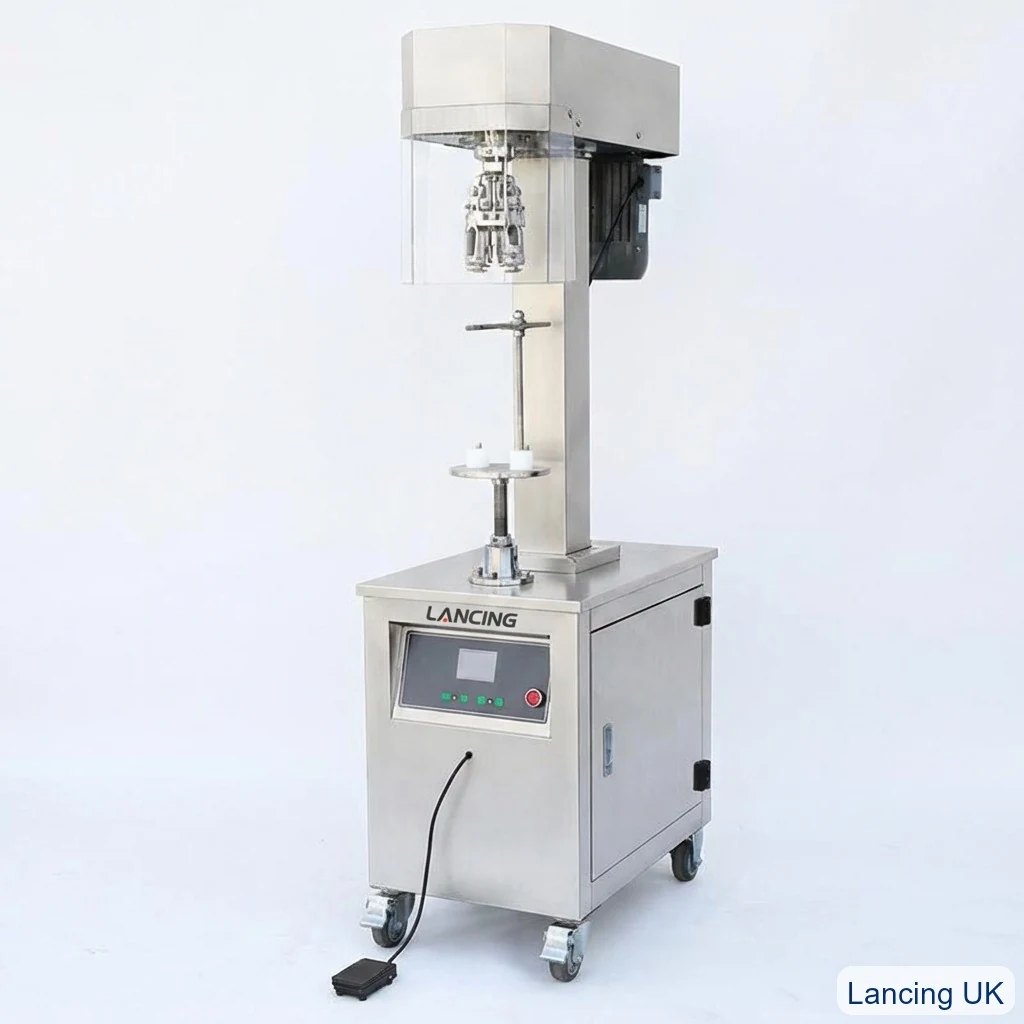
Semi-automatic capping may reduce automatic-feed changeover where an operator can place and inspect caps. Review the semi-auto route.
Contract packers often need flexibility across brands, bottle sizes, cap designs and order volumes. A ROPP capping machine should therefore be specified around changeover, sample approval and repeatable QA checks.
Flexible production
A semi-automatic ROPP capper may be useful for frequent short runs and trial work, while an automatic system may suit regular contracts with defined bottle and cap formats.
The best specification starts with a format matrix: all cap sizes, bottle heights, neck finishes, expected run lengths and the required changeover time between products.
Specification guide
Flexibility and repeatability should be balanced against output requirement.
| Area | Why it matters | Action |
|---|---|---|
| Trial and short runs | Semi-automatic capper | Fast setup and lower complexity |
| Regular customer formats | Inline automatic capper | Repeatable production once formats are defined |
| High-volume contracts | Rotary capper | Suitable where format consistency and output justify the investment |
Process
These steps help turn the search query into a working ROPP capping specification.
Build a format matrix.
Group similar cap and bottle formats.
Define change parts.
Create QA checks per customer.
Plan upgrade path as volumes grow.
Related ROPP guidance
These pages cover the wider equipment range, technical checks and the enquiry route for samples and quotations.
FAQ
It depends on the run lengths and format variety. Semi-automatic systems suit flexibility, while automatic systems suit repeated volume.
Often yes, if change parts and settings are planned around the expected format range.
Every customer bottle and cap combination should be checked for torque, leakage and tamper-band finish.
Not if the work is mostly small, varied runs. Flexibility may matter more than speed.
Send your cap size, bottle height, neck finish, samples and target output for practical advice.
Multi-customer control
Contract packing flexibility comes from controlled format governance, not from one generic machine setting. The customer’s bottle, closure and acceptance method must remain traceable through trial, production and retained samples.
| Control file | Contract-packer content | Production release |
|---|---|---|
| Format matrix | Customer, bottle, cap, liner/insert, decoration, parts and approved settings. | Correct physical parts and record selected before first-off. |
| Packaging lots | Bottle and closure supplier references and lot identity for each run. | Unapproved or changed components held for review. |
| Quality plan | Customer-specific visual, opening, leak and tamper-band methods and limits. | First-off and routine samples approved by the named authority. |
| Changeover record | Line clearance, cleaning, parts, settings, cap-feed route and inspection setup. | No previous customer material or settings remain in the cell. |
| Deviation file | Rejected samples, fault pattern, disposition, rework and authorised release. | Customer requirements remain distinct and auditable. |
Semi-automatic capping may reduce automatic-feed changeover where an operator can place and inspect caps. Review the semi-auto route.
Automatic feeding and change parts can be justified when the format is stable enough for controlled transfer and inspection.
Treat it as a new sample trial, even when cap diameter resembles an existing job.
Use the change-parts matrix and cap-feed checklist to define every customer change.
Use the quality-inspection plan to provide raw, traceable results rather than a generic line-pass statement.
Send the customer bottle/cap combinations, run lengths, changeover pattern, cap-supply method and quality requirements.
Multi-customer format control
Maintain a controlled format matrix linking each customer’s bottle, closure, liner/insert, product condition, machine parts, settings, approved sample, inspection method and changeover record. A cap diameter alone is not enough to release a format or assume common tooling.
Use revision-controlled drawings, supplier references, component lots and labelled change parts.
Verify cleaning, parts, settings, first-off samples and customer-specific quality checks.
Include setup, cap replenishment, inspection, rejects and customer changeovers in accepted-output planning.