
Inline ROPP capping machines for conveyor-fed production lines.
An inline ROPP capping machine is suited to bottling lines where containers travel on a conveyor from filling into capping, labelling, coding and packing. The key is smooth bottle transfer and repeatable cap placement.
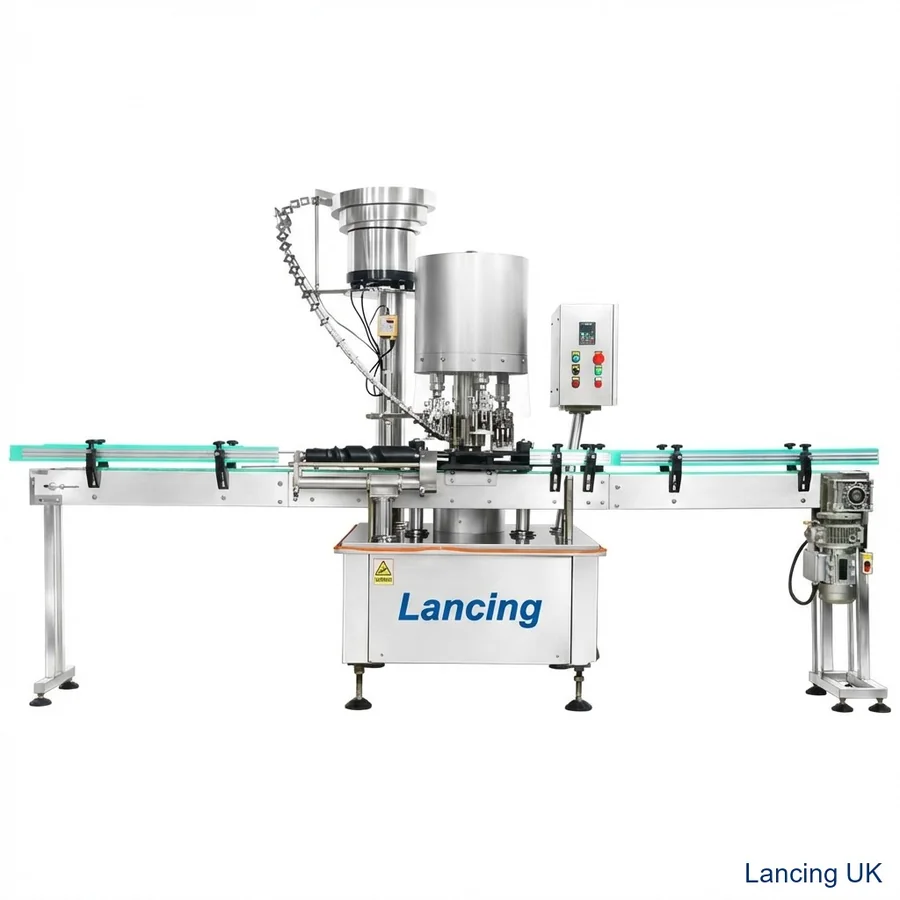
Line integration
Inline capping must match upstream and downstream flow.
The machine is only one part of the line. It needs correct spacing from filling, stable bottle control during cap placement and enough downstream space for inspection, labelling or accumulation.
Inline systems are often chosen when production has outgrown manual cap placement but does not need the highest rotary speeds. The design may include cap elevators, sorters, pick-and-place units or mechanical cap presentation depending on the closure.
Integration checks
- Existing conveyor speed
- Bottle pitch and spacing
- Cap feeding route
- Control panel interface
- Guarding and access
- Reject/inspection point
- Downstream labeller position
- Future format changes
Specification guide
Inline ROPP capping project checks
A good layout reduces line stops and cap placement issues.
| Area | Why it matters | Action |
|---|---|---|
| Bottle infeed | Controls stability | Review guides, spacing screws or starwheels |
| Cap placement | Controls accuracy | Confirm cap feed and placement method |
| Outfeed | Controls line flow | Allow space for inspection, coding and labelling |
Process
Practical route from enquiry to production.
These steps help turn the search query into a working ROPP capping specification.
1. Survey conveyor and bottle flow
Survey conveyor and bottle flow.
2. Define cap feed method
Define cap feed method.
3. Confirm head count and capping cycle
Confirm head count and capping cycle.
4. Plan controls and guarding
Plan controls and guarding.
5. Commission under real production speed
Commission under real production speed.
Related ROPP guidance
Continue the machine-selection process.
These pages cover the wider equipment range, technical checks and the enquiry route for samples and quotations.
FAQ
Questions about inline ropp capping machine.
What is an inline ROPP capping machine?
It is a conveyor-fed ROPP capper designed to work as part of a bottling or packaging line.
Is inline capping faster than semi-automatic capping?
Usually yes, because bottle movement and cap placement can be integrated with line flow.
Does inline ROPP need automatic cap feeding?
Often yes, although the exact method depends on the line and closure.
Can inline ROPP capping be retrofitted?
Often it can, but existing conveyor space, controls and bottle stability need to be reviewed.
Need help with this ROPP capping requirement?
Send your cap size, bottle height, neck finish, samples and target output for practical advice.
Inline architecture decision
When is an inline ROPP capper preferable to a rotary machine?
An inline capper can suit a conveyor-led project where the required accepted output, bottle stability and cap-feed rate can be achieved with simpler transfer and fewer capping stations. A rotary machine becomes relevant when the higher output justifies controlled pitch, starwheel transfer, multiple heads and more format-specific parts.
| Decision factor | Inline focus | Rotary focus |
|---|---|---|
| Bottle flow | Stable conveyor spacing and controlled infeed/outfeed. | Positive transfer into and through a synchronised turret. |
| Format parts | Guides, supports, cap transfer and head setting. | Starwheels, guides, supports, feeder parts and head/station setup. |
| Acceptance | Connected-line stops, cap feed, rejects and accepted output. | The same controls plus head-by-head sampling and transfer timing. |
Review rotary ROPP architecture or define the common output test.