
Head matrix
Sample and identify every active head at agreed points in the run.
A rotary ROPP capping machine uses multiple heads and controlled bottle transfer to increase throughput while keeping the forming process consistent. It is usually chosen for repeatable, higher-volume production formats.
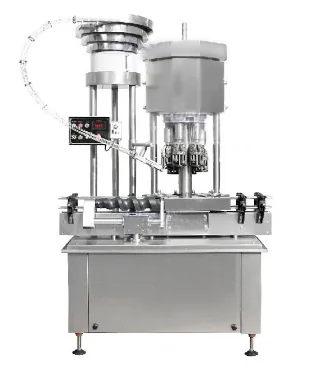
High output
Rotary cappers use starwheels, guides and head timing to maintain bottle position during cap application. This makes format consistency important: bottle diameter, height, neck position and cap dimensions all need to be controlled.
For suitable applications, a rotary ROPP system can deliver smoother continuous output than stop-start semi-automatic capping. Lancing UK can discuss whether a rotary route is appropriate for your bottle and cap samples.
Specification guide
Rotary capping is powerful when the pack format is suitable.
| Area | Why it matters | Action |
|---|---|---|
| Higher throughput | More heads increase output | Best for stable and repeatable formats |
| Controlled handling | Starwheels position bottles | Requires accurate change parts |
| Consistent forming | Repeatable head action | Needs sample trials and setup validation |
Process
These steps help turn the search query into a working ROPP capping specification.
Confirm high-speed requirement.
Review bottle and cap tolerances.
Specify starwheels and heads.
Plan cap feed and guarding.
Commission with torque and band checks.
Related ROPP guidance
These pages cover the wider equipment range, technical checks and the enquiry route for samples and quotations.
FAQ
When output requirements are high and bottle/cap formats are consistent enough for rotary handling.
It can be, but additional change parts may be required for different formats.
It can improve consistency when the machine is correctly specified and set up.
Yes. Rotary cappers are commonly used in automated bottling and packaging lines.
Send your cap size, bottle height, neck finish, samples and target output for practical advice.
Rotary production proof
A credible figure states the bottle and closure, number of active heads, cap-feed condition, connected equipment, run duration, good bottles, rejects, stops and finished-pack tests. Gross turret cycles do not show whether every head produced acceptable closures throughout the observed period.
Sample and identify every active head at agreed points in the run.
Record cap starvation, bottle transfer faults, blocked outfeed, rejects and planned checks separately.
Calculate accepted bottles over the agreed clock period and keep the assumptions with the result.