
Cap supply
Map storage, orientation, chute buffer and capper signals with the cap-feed guide.
ROPP capping works best when the whole production line is planned around bottle handling, cap placement, torque checks and downstream labelling or coding. Integration avoids bottlenecks and reduces avoidable line stops.
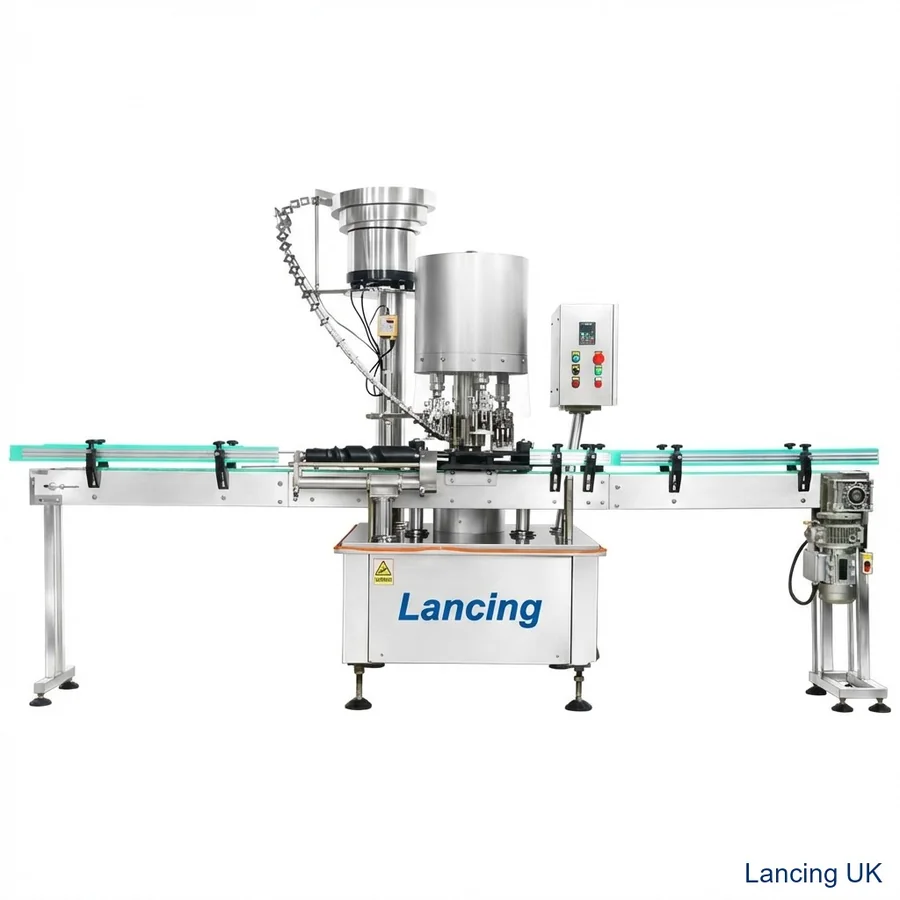
Line design
The filler, capper, conveyor, labeller and coder all influence one another. For example, product residue at the neck can affect sealing, bottle spacing can affect cap placement, and downstream label positioning may need a stable outfeed from the capper.
Lancing UK can discuss whether the ROPP capper should be supplied as a standalone machine or as part of a wider filling and packaging solution.
Specification guide
Addressing these early helps protect output and quality.
| Area | Why it matters | Action |
|---|---|---|
| Bottle spacing mismatch | Cap placement errors | Review infeed control before quotation |
| Residue on neck | Sealing and grip issues | Review filling accuracy and drip control |
| No inspection point | Missed quality faults | Plan torque, leak or visual checks after capping |
Process
These steps help turn the search query into a working ROPP capping specification.
Map the production line.
Confirm speed and accumulation needs.
Place capper relative to filler.
Plan cap feed and safety guarding.
Validate line with real packs.
Related ROPP guidance
These pages cover the wider equipment range, technical checks and the enquiry route for samples and quotations.
FAQ
Often yes, but the existing conveyor, bottle spacing and controls need review.
Usually after capping, but line layout and product requirements should be checked.
Yes. Lancing supplies filling, capping, labelling and packaging machinery.
Residue around the neck can affect sealing performance and cap grip during application.
Send your cap size, bottle height, neck finish, samples and target output for practical advice.
Controls and accumulation
Stable running depends on bottle spacing, cap availability, downstream capacity and a controlled response to stops. The interface schedule should describe both normal signals and recovery from abnormal states.
| Line state | Capper / feeder response to define | Pack risk to control |
|---|---|---|
| Upstream starved | Remain ready or stop in a controlled condition; maintain safe cap-feed state. | Unnecessary cycling, cap release without bottle or unstable restart. |
| Cap low or feeder fault | Warn, stop at an agreed threshold and retain the status of bottles already in the machine. | Uncapped, double-capped or uncertain bottles entering outfeed. |
| Downstream blocked | Use accumulation or controlled stop before pressure reaches the capping station. | Bottle collision, damaged cap finish or loss of bottle location. |
| Emergency stop | Move to the defined safe condition and require an authorised recovery sequence. | Releasing bottles whose cap cycle was interrupted. |
| Restart | Identify, inspect or reject bottles in uncertain positions before automatic flow resumes. | Mixing unverified packs with accepted production. |
| Format change | Confirm parts, settings, recipe/controls and first-off approval across all connected machines. | Wrong guide, cap feed or inspection setting. |
Map storage, orientation, chute buffer and capper signals with the cap-feed guide.
Map conveyors, access, utilities and handover responsibilities with the installation guide.
Witness normal and abnormal states in the FAT plan and transfer site-only checks into SAT.
Send the line layout, conveyor data, cap feed, signal schedule, inspection route and blocked-line strategy.
Controls handover
Define run permission, ready, healthy, starved, blocked, cap-low, fault, reject unavailable, emergency-stop boundary and reset. For each signal, state which machine sends it, which machine receives it, the normal state, the required response and how restart is authorised.
| State | Typical question to resolve | Acceptance test |
|---|---|---|
| Starved infeed | Does the capper pause without releasing an uncertain bottle or cap? | Interrupt bottle supply and observe controlled stop/restart. |
| Blocked outfeed | How much accumulation is allowed and who stops first? | Simulate the downstream blocked state and verify containment. |
| Cap-low or cap jam | How are uncapped or unverified bottles prevented from passing? | Remove cap availability and prove alarm, inhibition or reject response. |
| Fault reset | Which bottles require clearing or reinspection before restart? | Introduce the agreed fault and trace all affected packs. |
Open the full controls guide and download the blank interface schedule.
Downstream quality integration
The integration boundary extends from stable bottle presentation and inspection triggering through tracking, reject actuation, reject confirmation and failed-container containment. The line-control schedule should define permissives, healthy states, blocked or full reject conditions, lost tracking, stop category, reset authority and restart checks.
Place the inspection where the cap feature is visible and the bottle can be controlled without introducing a new transfer fault. Confirm that the inspection-to-reject distance remains traceable through normal speed changes and stops.