
Bottle position
Define valid spacing and presence at cap release, transfer and capping. Test missing, doubled, skewed and stalled bottles.
Define the signals, sensors, operating states, fault responses and reset rules that connect the cap feeder, conveyors, capper, inspection and neighbouring machines.
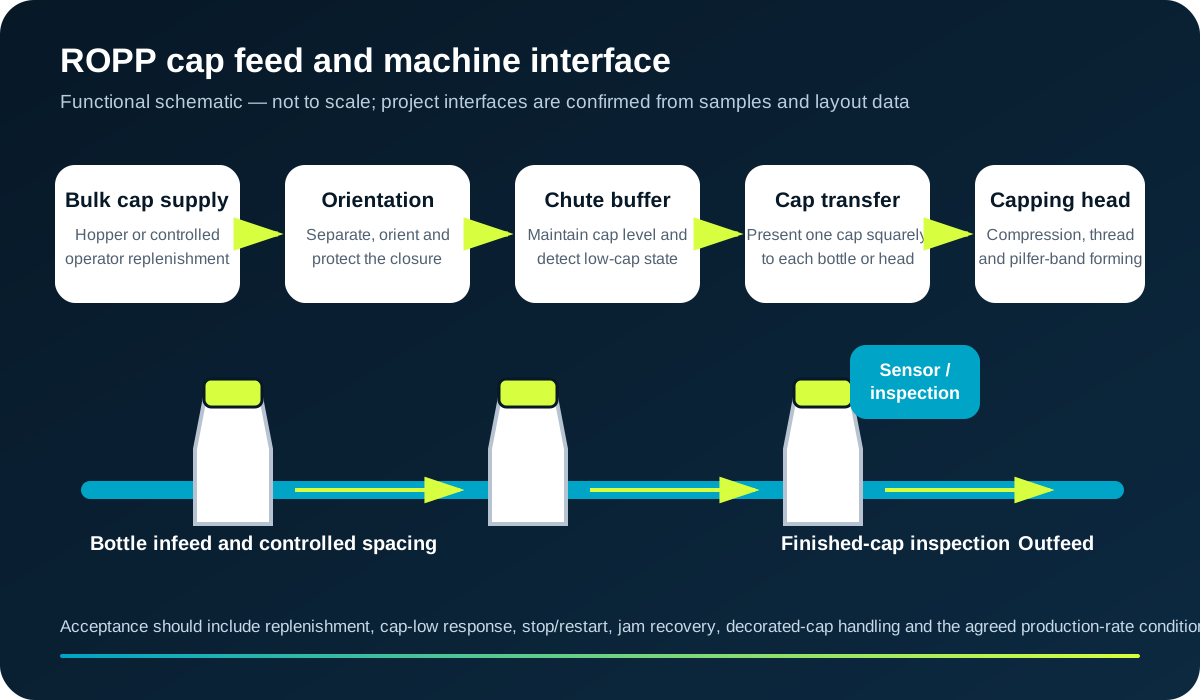
Answer first
It should identify every operating and fault state that crosses the boundary between the cap feeder, bottle conveyor, capper, inspection/reject equipment and adjacent machines. For each signal, define its source, destination, normal state, trigger, required response, reset condition, owner and FAT/SAT test.
The schedule should be agreed before controls are finalised. A late assumption about who stops, holds or releases bottles can create unverified packs, nuisance stops or unsafe recovery work.
Interface schedule
| State or signal | Question the functional specification must answer |
|---|---|
| Ready/healthy | Which preconditions are proved before bottles or caps may be released? |
| Run permission | Which machine owns the line request and what happens when permission is removed? |
| Starved infeed | Does the capper finish, hold or abort its current bottle, and how is restart controlled? |
| Blocked outfeed | How much accumulation is allowed and which equipment stops first? |
| Cap low / cap unavailable | How are uncapped or unverified bottles inhibited, contained or rejected? |
| Fault | Which equipment stops, what alarm is shown and which packs enter the fault window? |
| Reject unavailable | Does production stop if reject confirmation or reject capacity is lost? |
| Reset | Who may reset, which guards/conditions must be proved and how are affected bottles handled? |
Detection and response
A sensor is useful only when the control response and affected-bottle route are defined.
Define valid spacing and presence at cap release, transfer and capping. Test missing, doubled, skewed and stalled bottles.
Define bulk-low, chute-low, cap-present and jam conditions. State whether the bottle is inhibited, stopped, marked or rejected.
Define what is measured, how the result follows the bottle, reject actuation, confirmation, bin-full response and reconciliation.
Functional sequence
Prove required guards, safety functions, utilities, cap supply, bottle path, reject route and connected-machine states before enabling production.
Define how conveyors, cap feed and capping sequence establish stable flow and how first-off bottles are identified and released.
State whether current cycles complete, where bottles are held and which buffers may clear.
Contain the hazard and identify bottles whose cap status or inspection result is uncertain.
Clear or segregate affected packs, correct the cause, prove the required conditions and authorise restart using the written sequence.
FAT and SAT
| Test | Expected evidence |
|---|---|
| Remove bottle supply | Controlled starved response, no unintended cap release and defined restart. |
| Remove cap availability | Alarm/inhibition or reject behaviour that prevents an unverified pack from acceptance. |
| Block outfeed | Managed accumulation, stop hierarchy and recovery without bottle or cap damage. |
| Open permitted guard/access | Specified protective response, controlled machine state and authorised reset. |
| Interrupt power or communications | Defined safe/fault state and traceable treatment of bottles remaining in the system. |
| Disable reject confirmation | Fault response that prevents unconfirmed rejects from being treated as accepted production. |
Quotation input
Send the line layout, adjacent-machine makes or available interface details, operating direction, conveyor data, target accepted output, bottle spacing, cap-feed method, inspection/reject requirement, preferred control platform if mandatory, network/data boundary and site safety responsibilities.
Required controls, sensors, safety functions and signals remain project-specific until confirmed in the written machine and line scope.
ROPP line-control interface schedule (CSV)
Use one row per signal or state and carry the same identifier through design review, FAT, installation and SAT.
Buyer questions
There is no universal answer. Choose ownership from the complete line function, accumulation, process risk and supplier boundaries, then document who requests running, who may stop and how each machine responds.
The response depends on buffer capacity and detection. The control must prevent bottles without a verified cap from passing as accepted production and should give the operator enough information to replenish or clear the fault safely.
No. Bottle presence confirms only that a bottle reached a location. Cap presence, application quality and reject confirmation require the detection or inspection methods defined for the project.
Retain the timestamp, machine state, fault code, affected-bottle range or count, operator action, recovery confirmation and any inspection or reject result needed by the customer’s production system.
Send the line layout, adjacent-equipment details, bottle and cap flow, required states, inspection route and site controls standard.
Inspection interface
A camera-ready or sensor-healthy signal is not enough on its own. The connected sequence may also need bottle-present, trigger, result-valid, result identity, reject request, reject actuation, reject confirmation, bin-full, tracking-lost, recipe-valid and system-fault states. The responsible controller and response must be defined for each signal.
Challenge the sequence during speed changes, closely spaced failures, stops between inspection and rejection, blocked reject conditions and authorised recovery.
Link signal name, direction, normal state, timeout, fault response, reset owner and FAT/SAT result to the same line revision.