
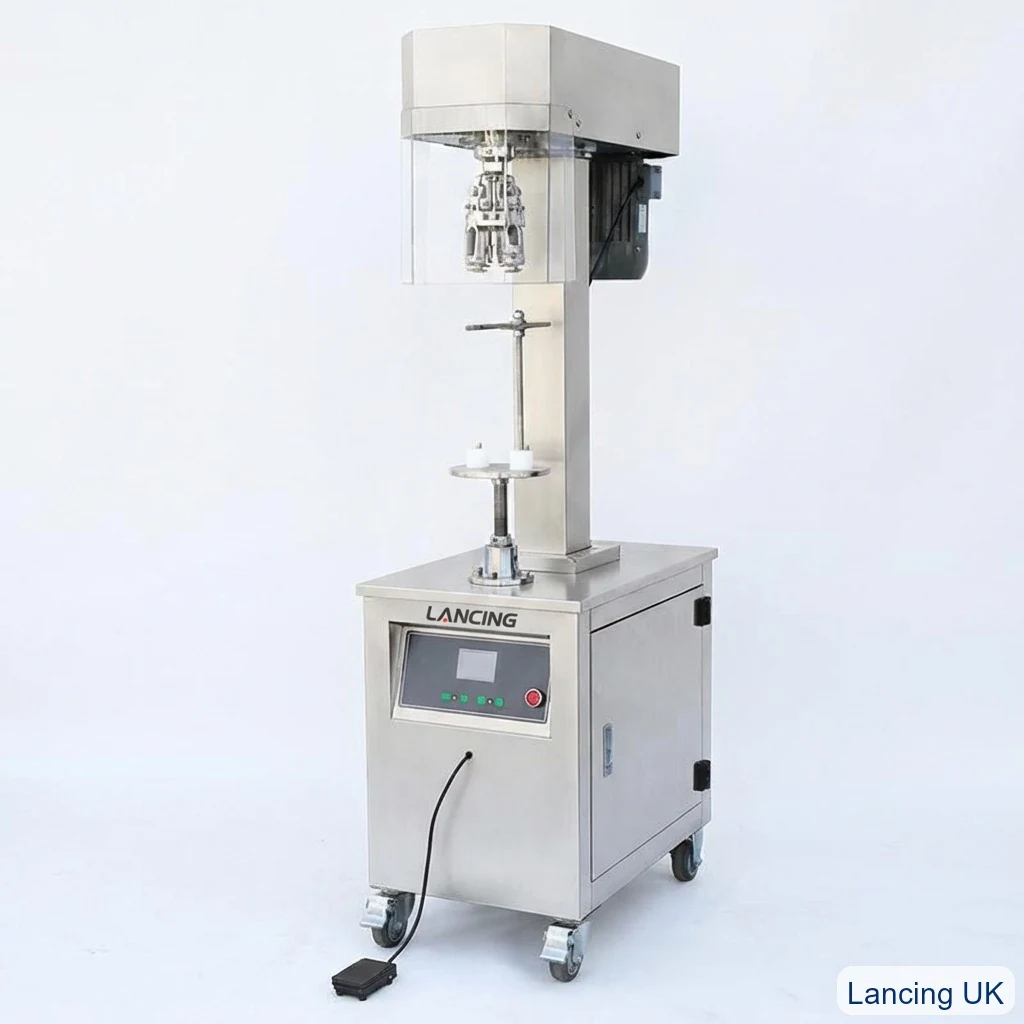
ROPP capping machines for suitable plastic bottles and aluminium caps.
Some plastic bottles can be suitable for ROPP capping, but they require careful checking. The neck must be rigid enough to support forming pressure, and the bottle design must maintain cap alignment during the cycle.
Suitability checks
Plastic bottle rigidity is a key ROPP capping factor.
Because the cap is rolled onto the bottle, the neck must resist deformation. Lightweight bottles may distort under top pressure or produce inconsistent threads and tamper bands.
Before specifying a machine, samples should be assessed under realistic conditions, including filled weight, product temperature and any neck residue. Testing helps identify whether ROPP is the correct closure route.
Plastic bottle details
- Bottle material and wall thickness
- Neck rigidity
- Thread and bead design
- Filled weight
- Top-load tolerance
- Product temperature
- Bottle shoulder support
- Leak and torque target
Specification guide
Plastic bottle ROPP risks
These areas should be tested before committing to a machine specification.
| Area | Why it matters | Action |
|---|---|---|
| Neck flex | Inconsistent cap formation | Test samples under capping pressure |
| Bottle squeeze | Poor handling stability | Review guides and support |
| Heat or residue | Seal variation | Test with real filled conditions |
Process
Practical route from enquiry to production.
These steps help turn the search query into a working ROPP capping specification.
1. Review plastic bottle samples
Review plastic bottle samples.
2. Check neck rigidity
Check neck rigidity.
3. Trial cap forming pressure
Trial cap forming pressure.
4. Measure torque and leakage
Measure torque and leakage.
5. Decide suitability or alternative closure route
Decide suitability or alternative closure route.
Related ROPP guidance
Continue the machine-selection process.
These pages cover the wider equipment range, technical checks and the enquiry route for samples and quotations.
FAQ
Questions about ropp capping machine for plastic bottles.
Can ROPP capping work on plastic bottles?
It can for suitable bottles, but neck rigidity and closure compatibility must be checked.
Why are plastic bottles harder to assess?
They may flex under capping pressure, affecting thread formation and sealing consistency.
Should samples be filled for trials?
Yes. Filled conditions can change bottle stability and top-load behaviour.
Can Lancing advise on suitability?
Yes. Send sample bottles and caps for practical review.
Need help with this ROPP capping requirement?
Send your cap size, bottle height, neck finish, samples and target output for practical advice.
Container support
When does a plastic bottle need additional support during ROPP capping?
Additional support may be needed when the bottle, shoulder or neck deforms under the axial load required to compress the liner and form the closure. Trial the actual resin, wall distribution, fill condition and temperature, then define the support geometry that protects the container without obstructing the tamper band.
| Observation | Possible project response |
|---|---|
| Shoulder or body collapse | Review neck support, bottle platform, fill condition and applied load. |
| Cap sits unevenly | Check finish alignment, support centreline and cap presentation. |
| Finish damage or whitening | Review material/finish suitability, roller contact and trial acceptance limits. |
Resolve plastic bottle suitability before assuming a ROPP route
Begin with a suitability question, rather than an assumption that every plastic bottle can be processed like a glass format. Ask the bottle and closure suppliers for the intended application and available neck-finish information. Identify material and component revisions so the reviewed pairing is unambiguous.
Use samples representative of the production pack and record their condition during the review. If the current bottle or cap remains provisional, keep that uncertainty visible in the quotation. A successful result on a substitute pack should not be used as final approval of the launch components.
- Component match
- Confirm which bottle and aluminium closure pairing is being assessed and retain the relevant supplier references.
- Support evidence
- Document the proposed bottle support and inspect the trial pack for unwanted movement or deformation.
- Approval record
- Link the agreed closure checks and finished samples to the precise format and conditions demonstrated.
Can plastic bottle suitability be confirmed from a photograph?
A photograph supports the initial discussion; component information and representative trials are needed for a pack-specific decision.
What if the bottle changes after quotation?
Treat the replacement as a format revision and ask whether the earlier suitability and tooling conclusions still apply.