
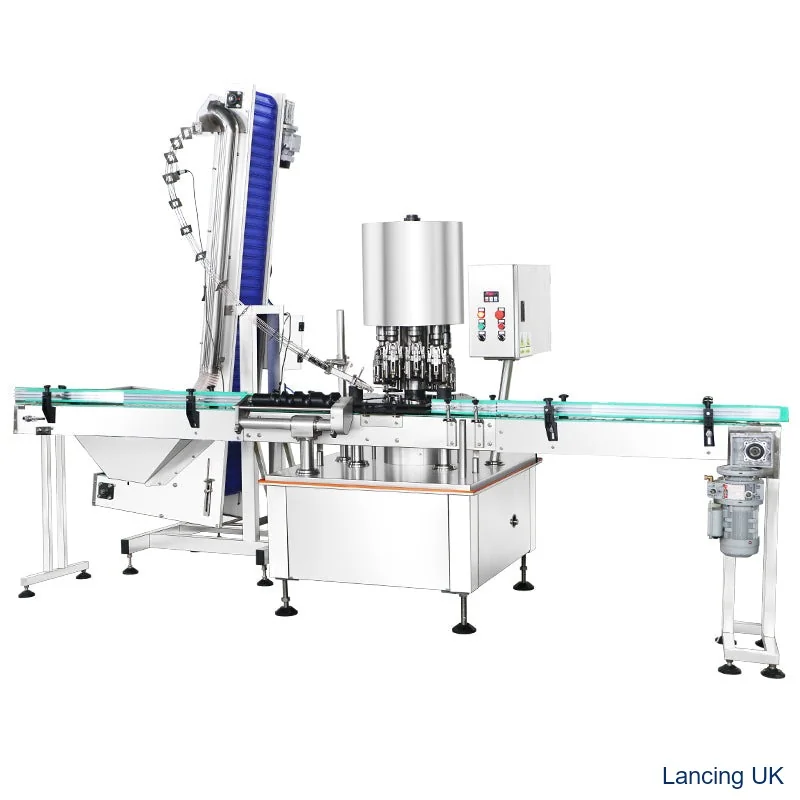
Pilfer proof capping machines for tamper-evident bottle closures.
ROPP is a common pilfer-proof capping method because it forms the aluminium cap and tamper band directly onto the bottle neck. The result is a closure that shows visible evidence when the pack has been opened.
Tamper evidence
The pilfer band must be formed consistently.
Pilfer-proof capping quality depends on the lower band being tucked under the retaining bead without tearing, loosening or scuffing the cap. This requires the correct cap design, neck finish and roller setup.
A good pilfer-proof capping system should be judged by torque, sealing performance and visible band quality. Production checks should include opening feel, bridge break, cap appearance and leakage where relevant.
Quality checks
- Bridge break appearance
- Tamper band tuck
- Cap skirt finish
- Opening torque
- Liner compression
- Leak performance
- Thread formation
- Cap print/scuff inspection
Specification guide
Pilfer-proof capping considerations
These checks determine whether the finished closure protects product quality and customer confidence.
| Area | Why it matters | Action |
|---|---|---|
| Band not tucked | Poor opening evidence | Review lower roller height and bottle bead compatibility |
| Cap scuffing | Brand appearance issue | Check tooling, cap finish and roller pressure |
| Low torque | Poor sealing or loose feel | Check top pressure, liner, thread formation and cap dimensions |
Process
Practical route from enquiry to production.
Follow one labelled bottle and closure through forming and the first-opening check.
1. Confirm cap and neck compatibility
Use the bottle retaining feature and closure bridge design from the intended pairing. Similar diameters can have different forming requirements.
2. Set top pressure and bottle support
Check stable bottle location and liner contact using the approved setup. Identify the packaging lot used for the first-off check.
3. Adjust thread rollers
Observe thread definition around the actual finish. Any adjustment belongs to the approved machine setup procedure.
4. Adjust pilfer band rollers
Inspect band position under the retaining feature and the condition of the bridges before first opening.
5. Validate opening evidence and torque
Record the opening test and the visible evidence after opening on the same labelled sample. Opening torque alone does not prove band function.
Related ROPP guidance
Continue the machine-selection process.
These pages cover the wider equipment range, technical checks and the enquiry route for samples and quotations.
FAQ
Questions about pilfer proof capping machine.
What does pilfer proof mean?
It means the closure gives visible evidence of opening, typically through a tamper-evident band or bridge system.
Is ROPP a pilfer proof capping method?
Yes. ROPP stands for roll-on pilfer-proof and is widely used with aluminium closures.
Can the pilfer band fail?
Yes. Incompatible bottles, poor roller setup or unsuitable caps can cause band faults.
Does tamper evidence replace leak testing?
No. Tamper evidence and sealing performance should both be checked where product leakage matters.
Need help with this ROPP capping requirement?
Send your cap size, bottle height, neck finish, samples and target output for practical advice.
Tamper-band function
What proves that a pilfer-proof ROPP closure is functioning?
Prove that the band is formed in the intended position, the bridges remain intact after capping and distribution handling, and the band separates or gives the specified visible evidence on first opening. Use the closure owner’s approved method and retain unopened and opened reference samples.
| Check | Evidence |
|---|---|
| After capping | Band position, tuck, bridge condition, shell damage and cap seating. |
| After conditioning | Leak/storage result and confirmation that bridges remain intact before opening. |
| First opening | Opening method, bridge separation, retained band behaviour and visible evidence. |