
Pack stability
Check bottle base, neck support, height, weight and resistance to downward forming load.
A table top or compact semi-automatic ROPP capping machine is useful when production volumes do not justify a fully automatic cap feeding system. The operator places the bottle and cap, while the machine forms the closure under controlled pressure.
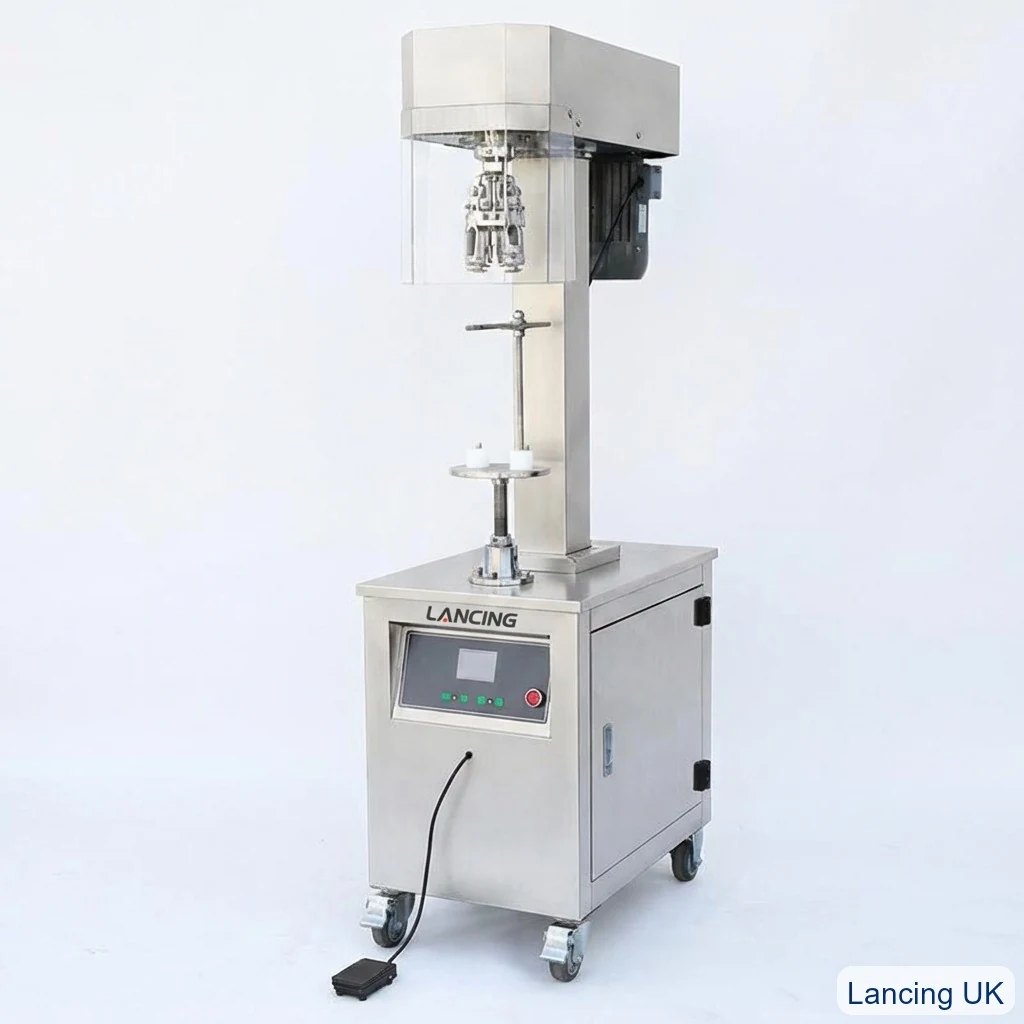
Semi-automatic operation
For low to medium volumes, the priority is usually controlled capping quality rather than maximum speed. A table top ROPP capper can help prove closure compatibility, support pilot production and handle multiple product variants with manageable changeover.
For best results, treat the cap, bottle and machine as one system. Lancing UK can review samples and advise whether a semi-automatic, inline automatic or rotary multi-head ROPP capping system is the correct route.
Selection table
Use these checks to narrow the machine choice and avoid packaging compatibility problems.
| Area | Why it matters | Action |
|---|---|---|
| Manual cap placement | Operator controls bottle and cap loading | Good flexibility but lower throughput |
| Adjustable bottle support | Supports different bottle heights | Important for clean cap presentation |
| Documented settings | Records pressure and setup for repeat batches | Helps repeat successful trials |
Process
A documented setup gives better repeatability and easier troubleshooting.
Set the bottle height support.
Place cap squarely on the bottle neck.
Run sample caps at low speed or single-cycle operation.
Inspect cap height, thread and tamper band.
Measure opening torque before approving production.
Related ROPP guidance
These pages cover machine range, automatic options, troubleshooting and the enquiry route for bottle and cap samples.
FAQ
Yes for suitable low-volume or batch production, provided speed and operator workflow match the production target.
Often yes, but cap size, bottle height and neck finish changes may need adjustment or tooling.
Table top and semi-automatic ROPP machines usually rely on manual cap placement, although exact configuration depends on the model.
The machine controls pressure and roller forming more consistently than a manual process.
Send your cap size, bottle height, neck finish, samples and target output for practical advice.
Compact machine decision
A table-top format can suit development, laboratory-style trials and controlled short runs when the bottle remains stable, the cap can be placed squarely, the required forming load is supported and the operator can work safely. Suitability must be proved with the production bottle and closure rather than footprint alone.
Check bottle base, neck support, height, weight and resistance to downward forming load.
Trial cap placement, bottle location, controls, unloading and inspection at the intended bench height.
Retain approved samples, settings, tooling identity and the accepted output under the agreed operator method.
Review short-run production planning and record accepted output.