
Protect presentation
Use the cap-feed guide to separate feed marks from forming marks.
Spirits packaging often needs a premium visual finish, clear tamper evidence and consistent opening feel. ROPP capping is suited to many spirits bottles, miniatures and specialist glass formats when the closure and neck finish are matched.
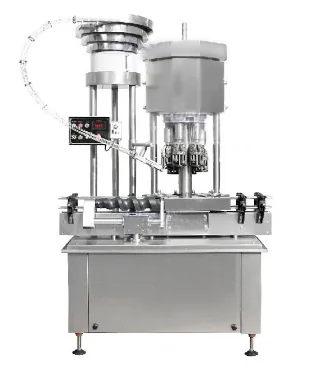
Premium closure control
Decorated aluminium closures, unusual bottle shapes and miniature formats can require extra attention to bottle support and cap presentation. Machine trials help confirm that the cap sits squarely, seals properly and opens cleanly.
For best results, treat the cap, bottle and machine as one system. Lancing UK can review samples and advise whether a semi-automatic, inline automatic or rotary multi-head ROPP capping system is the correct route.
Selection table
Use these checks to narrow the machine choice and avoid packaging compatibility problems.
| Area | Why it matters | Action |
|---|---|---|
| Miniatures | Need precise bottle location and gentle handling | Avoids skewed caps and bottle instability |
| Premium printed caps | Need scuff checks after forming | Protects pack appearance |
| High-volume spirits lines | May suit automatic or rotary ROPP systems | Improves repeatability and output |
Process
A documented setup gives better repeatability and easier troubleshooting.
Supply bottle and cap samples from the intended production range.
Check bottle support, especially for tapered or miniature formats.
Trial cap forming and tamper band appearance.
Measure opening torque and reclose feel.
Record settings for repeatable production.
Related ROPP guidance
These pages cover machine range, automatic options, troubleshooting and the enquiry route for bottle and cap samples.
FAQ
Yes. Many spirits bottles use aluminium ROPP closures where tamper evidence and premium appearance are required.
Often yes, but small bottles need careful bottle support and presentation checks.
Some projects use pourers or inserts, but compatibility should be checked with the cap, bottle and product.
Decorated caps can scuff if tooling, cap finish or roller settings are not suitable. Visual inspection is important during trials.
Send your cap size, bottle height, neck finish, samples and target output for practical advice.
Premium spirits packs
Spirits packs can combine decorated aluminium, tapered or miniature bottles, pourers and brand-sensitive presentation. Each component changes handling or finished-cap inspection.
| Spirits pack feature | Trial question | Evidence |
|---|---|---|
| Decorated closure | Where can the shell contact guides, feeder surfaces, transfer and rollers? | Incoming, post-feed and post-cap close-up images against an agreed presentation standard. |
| Insert or pourer | Is it supplied loose, preassembled or seated at another station? | Component drawing, seating check, cap placement and leak/opening result. |
| Tapered or small bottle | How is the bottle centred and supported under forming load? | Stable first-off sample, support/change-part record and head-by-head checks. |
| Tamper band | Does the band tuck and bridge behaviour meet the closure specification? | Before/after-opening samples, close-up inspection and approved reference. |
| Multiple brands/formats | Which parts and settings change, and how is the next first-off pack released? | Format matrix, labelled parts and customer-specific quality record. |
Use the cap-feed guide to separate feed marks from forming marks.
Use the quality-inspection route to correlate decoration, band, opening and seal evidence.
Use the sample-trial record for full-size and miniature formats rather than assuming one setup transfers.
Send the bottle, cap, liner, insert/pourer, decoration standard, formats and target production condition.
Premium closure evidence
Use production-equivalent printed, lacquered, embossed or otherwise decorated closures and inspect every contact point from bulk handling to the finished bottle. Record cap scuffing, dents, transfer marks, seating, thread, band, opening and leak results with photographs and retained approved samples.
| Stage | Decoration check |
|---|---|
| Bulk feed | Rubbing, nesting, inversion and damage during replenishment/orientation. |
| Transfer | Chute, escapement, pick/place or applicator contact and cap squareness. |
| Forming | Pressure-pad and roller marks, shell deformation and artwork alignment. |
| Distribution sample | Appearance after the agreed handling, storage and opening method. |
Special closure assemblies
Where the aluminium shell works with a separate or preassembled insert, the trial must control the bottle neck, insert, liner and shell as one approved system. The capping head forms the shell around the bottle finish; it does not by itself establish insert retention, pouring performance or an anti-refill function.
Send the closure supplier’s drawings, assembly route, representative lots and the functional test method used by the pack owner. This allows cap feeding, bottle support, capping tooling and finished-pack checks to be assessed against the actual premium-spirit pack.