
ROPP capper selection for bottles, aluminium caps and production speed.
A ROPP capper forms an aluminium closure onto the bottle neck instead of simply tightening a pre-threaded screw cap. The machine applies top pressure, rolls the cap skirt into the neck thread and forms the pilfer band so the finished pack is resealable and tamper evident.
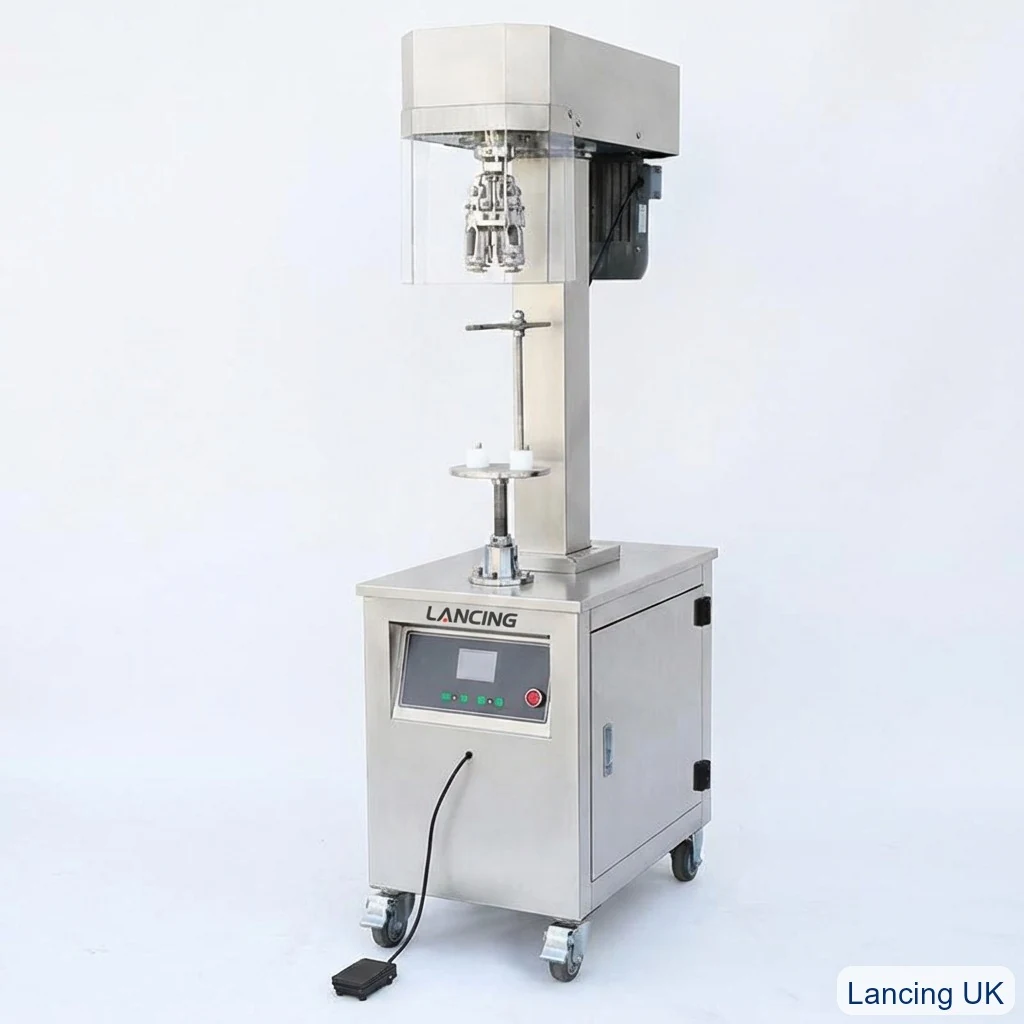
Machine choice
Choose the capper around your bottle, cap and output target.
The right ROPP capper depends on bottle rigidity, cap diameter, neck finish, cap feed method, production speed and the consistency required from shift to shift. A small batch line may only need a semi-automatic capper, while a filling line with continuous conveyors may require automatic cap placement and multiple capping heads.
For best results, treat the cap, bottle and machine as one system. Lancing UK can review samples and advise whether a semi-automatic, inline automatic or rotary multi-head ROPP capping system is the correct route.
Useful specification details
- Cap diameter and cap height
- Bottle neck drawing or sample bottle
- Bottle height and body shape
- Required bottles per minute
- Manual or automatic cap loading
- Torque or leak-test requirement
- Tamper band appearance target
- Future changeover formats
Selection table
Key checks before specifying equipment.
Use these checks to narrow the machine choice and avoid packaging compatibility problems.
| Area | Why it matters | Action |
|---|---|---|
| Semi-automatic ROPP capper | Batch work, laboratory trials and lower-volume production | Simple operation, quick setup and useful for multiple formats |
| Inline automatic ROPP capper | Conveyor-fed filling and labelling lines | Repeatable cap placement, controlled handling and better line flow |
| Rotary multi-head ROPP capper | High-speed production with consistent bottles and closures | Multiple heads increase throughput while maintaining a controlled forming sequence |
Process
How a ROPP capper creates the finished closure.
A documented setup gives better repeatability and easier troubleshooting.
1. Locates the bottle so the cap sits square on the neck
Locates the bottle so the cap sits square on the neck.
2. Applies vertical pressure to compress the liner against the sealing surface
Applies vertical pressure to compress the liner against the sealing surface.
3. Uses thread rollers to form the aluminium skirt around the bottle thread
Uses thread rollers to form the aluminium skirt around the bottle thread.
4. Uses lower rollers to tuck the pilfer band under the retaining bead
Uses lower rollers to tuck the pilfer band under the retaining bead.
5. Releases the bottle for torque, leak and visual inspection
Releases the bottle for torque, leak and visual inspection.
Related ROPP guidance
Continue the machine-selection process.
These pages cover machine range, automatic options, troubleshooting and the enquiry route for bottle and cap samples.
FAQ
Questions about ropp capper.
What is a ROPP capper?
A ROPP capper is a machine that applies roll-on pilfer-proof aluminium closures by forming the cap onto the bottle neck using pressure and rollers.
Is a ROPP capper the same as a screw capper?
No. A screw capper normally tightens a pre-threaded cap. A ROPP capper forms the thread and tamper band during the capping operation.
Can one ROPP capper run different cap sizes?
Often yes, but change parts and roller settings depend on the cap diameter, cap height, bottle neck finish and machine design.
What samples are needed for a ROPP capper quote?
The most useful samples are bottles, caps, neck drawings, speed target, product type and any torque or leak-test requirements.
Need help with this ROPP capping requirement?
Send your cap size, bottle height, neck finish, samples and target output for practical advice.