
ROPP cap sealing machine setup for leak control and tamper-evident finish.
A ROPP cap sealing machine must close the pack securely without damaging the cap, bottle or liner. The seal is created by the relationship between top pressure, liner compression, neck finish and the rolled aluminium cap profile.
Seal performance
Good sealing depends on measured setup, not just machine speed.
Leak complaints often come from packaging variation rather than a single machine fault. Bottle sealing surface, cap liner, cap height, fill residue and roller pressure all influence the result. For that reason, trials should check both visual finish and measured performance.
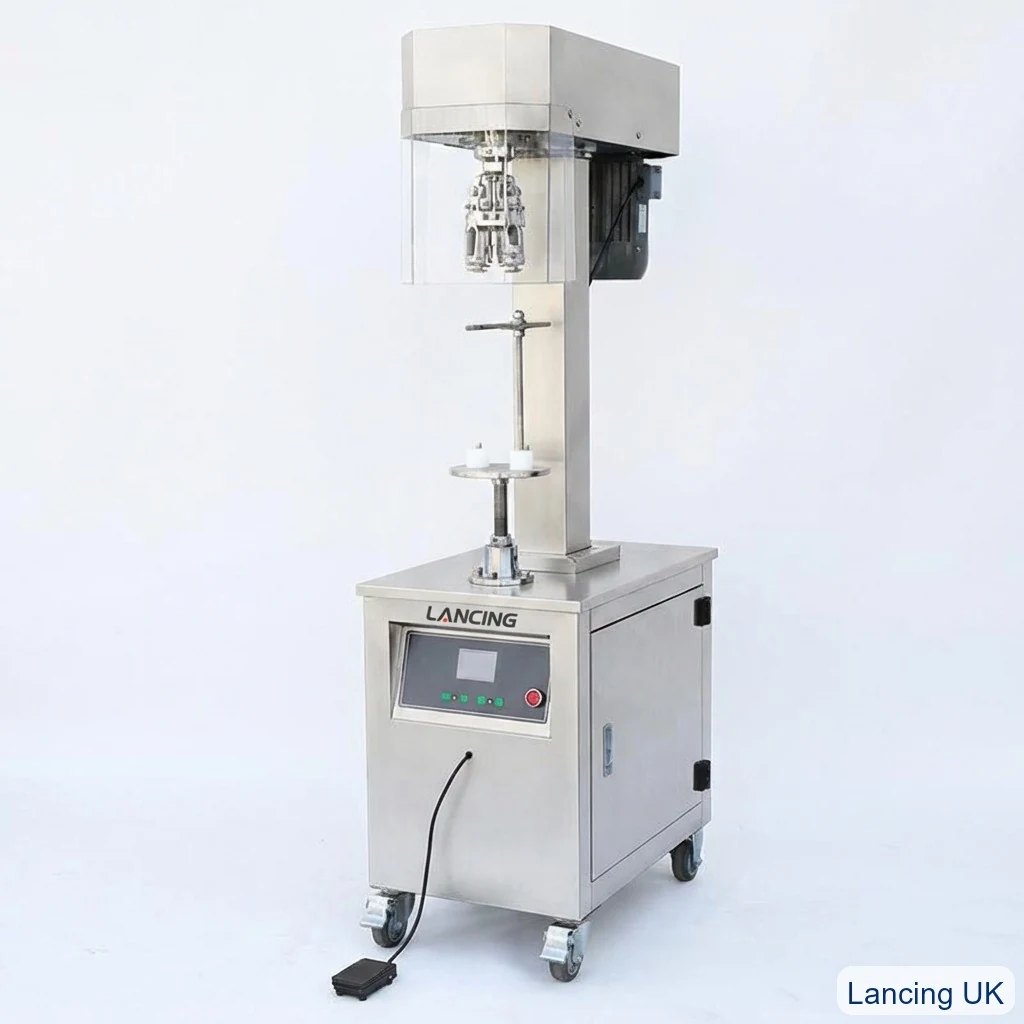
For best results, treat the cap, bottle and machine as one system. Lancing UK can review samples and advise whether a semi-automatic, inline automatic or rotary multi-head ROPP capping system is the correct route.
Seal checks to run
- Cap height after capping
- Liner compression mark
- Opening torque reading
- Bridge and band appearance
- Leak or inversion test
- Neck finish damage
- Cap scuffing or tearing
- Repeatability across samples
Selection table
Key checks before specifying equipment.
Use these checks to narrow the machine choice and avoid packaging compatibility problems.
| Area | Why it matters | Action |
|---|---|---|
| Leaking cap | Insufficient liner compression, damaged neck finish or contamination | Check top pressure, samples and bottle finish |
| Cap difficult to open | Excessive compression or aggressive thread formation | Check torque and reduce over-forming where appropriate |
| Poor tamper band | Lower roller or bead compatibility issue | Review cap drawing, bead geometry and band roller setup |
Process
Seal-control workflow.
A documented setup gives better repeatability and easier troubleshooting.
1. Start with clean bottle and cap samples from production batches
Start with clean bottle and cap samples from production batches.
2. Set cap height and top pressure before increasing speed
Set cap height and top pressure before increasing speed.
3. Check thread profile and tamper band formation
Check thread profile and tamper band formation.
4. Measure opening torque on multiple samples
Measure opening torque on multiple samples.
5. Record settings once the seal and appearance are accepted
Record settings once the seal and appearance are accepted.
Related ROPP guidance
Continue the machine-selection process.
These pages cover machine range, automatic options, troubleshooting and the enquiry route for bottle and cap samples.
FAQ
Questions about ropp cap sealing machine.
Does ROPP capping create a resealable cap?
Yes. After the pilfer band breaks on first opening, the main cap should be able to screw back onto the formed thread.
Why does a ROPP cap leak?
Leaks can result from poor liner compression, cap or neck mismatch, product on the sealing surface, insufficient top pressure or damaged bottles.
Can a cap be too tight after ROPP sealing?
Yes. Excessive top pressure or over-formed threads can increase opening torque and make the cap harder to open.
Should ROPP sealing be tested with water or product?
Initial trials may use water, but final checks should consider the real product because viscosity, residues and carbonation or volatility can affect performance.
Need help with this ROPP capping requirement?
Send your cap size, bottle height, neck finish, samples and target output for practical advice.
Seal-forming sequence
How do liner compression, thread rolling and tamper-band tuck interact?
Top pressure seats the closure and compresses the liner or sealing feature; thread rollers form the skirt around the bottle thread; tuck rollers form the lower band beneath the finish feature. Each action needs the correct timing, profile and support because improving one visual feature can disturb sealing or opening performance elsewhere.
| Function | Evidence to review |
|---|---|
| Seating/compression | Cap height, liner witness, leak result and bottle/finish condition. |
| Thread forming | Thread definition, shell marks, opening feel and repeatable removal method. |
| Band forming | Tuck position, bridges, first-opening separation and retained-band behaviour. |